Category Archives: personal testimony

history of personal belief and transformation

Toni Dillon.


The good teachers – the really good ones – don’t wait for rewards.
They’re usually too busy to market themselves to anybody. Anybody, that is, except their beloved students.

Such was the case with our Toni Dillon.

I’d met Toni at Lincoln Elementary, the big brick fortress on East 31st street where even my mother had been a student back in the 1920s. Having attended Lincoln myself, I was already familiar with the lay of the three floors, the hardwood, the massive stairwells, the big bay window in the largest Kindergarten classroom, and the steep auditorium whose stage was the lip of the gym. There were old school buildings all over Erie, but none quite like Lincoln.

Toni hadn’t grown up in our town. She was one of those special people who’d applied all around the country, and taken the first position that had opened up for her. Toni was from New Jersey, and probably one of only a handful of people from that state who had ever even been to Erie, Pennsylvania.

Newly bid into K-6 from the high schools, I was grateful to get one of the largest classrooms, an old art space complete with working sink, right across from the big Kindergarten with the bay window where I’d sat on the rug in 1962.

Toni was around the corner and across the hall, right near the door, and she had a whole wall of windows. Her students were the Emotional Support kids, boys, ages 9 – 11. Her room wasn’t huge, but it was packed with everything imaginable.

She had live critters everywhere, and growing things, and gizmos, and collections, and graphics, and all sorts of new activities to do every week, which she called her Projects. And, nobody was more enthusiastic about the latest Project than Toni, herself.

You could not contain your own energy when Toni was around. She was a whirlwind. She had to be; her boys, some of them fragile, many of them potentially volatile, needed her keen, undivided if indirect attention at every moment. And, Toni made it her mission to keep that attention, from the moment they passed through the door in the morning until they were safely on the bus at 2:30.

The reason I got to know Toni was all because of her personality; not a natural mixer, I was content to stay in my space. But, she loved to pop in, with an old filmstrip series found in a forgotten closet that she was sure I could use, or some other such reason to make contact. She called me RAZZ, a moniker I frankly enjoyed because, well, Toni “got” me; I, too, was enormously enthusiastic about my job as music teacher and, during those five years at Lincoln, probably the most committed and immersed in my role as I ever had been before or since.

The most admirable aspect of Toni was revealed to me the day she told me about her trips to the circus, with the one child in her class whom she had discovered to be essentially without family. This young boy, a slight little child with curly brown hair, had become a focus for Toni. Way beyond the call of duty, she had become a major part of his life. And, she did it simply because she was needed. Nothing ever stopped this woman from caring. Nothing.

The winter following my mother’s death, I’d spent Christmas day with almost everyone in my family except, of course, mum. The day was fractured by miscommunication. And, I, without going into detail, had been deeply hurt by the actions of my unwitting family. Running home to throw myself into bed and wail from the depths of grief and loss, I became quite hysterical and felt frightened by my despondency. I knew I needed to talk to somebody.

Toni was the first person who came to mind.

When I called her, she was actually home. And, she picked up. And, she listened. Toni listened, and let me cry it all out, and shared in my hurt and pain. She’d had similar experiences in her own family, as it turned out, and understood acutely everything that had just happened to me.

I never forgot that day. She may very well have saved my life.

As we proceeded through our teaching careers, forced to submit to the district’s bidding process, we were both moved out of Lincoln the same year, torn from students who had become such a part of our lives. Fatefully, the two of us ended up at Perry School, once again just down the hall from each other. And, for five more years, I was blessed again by her enormous heart.

But, the district would re – pair the schools, yet again, and this time I had to make the gut wrenching decision to leave Perry School. So, Toni and I were separated for the first time in nearly a decade.

Like too many teachers who had worked in those buildings, Toni had been diagnosed with cancer. She’d battled back, but this time the disease had moved further into her body and the fight was a full on suit of armor. We stayed in touch via email, Toni putting us all on a long list of friends and colleagues and, in true Toni style, mincing no words in describing her latest treatment plan and its progress.

For ten intense, exhausting years, Toni battled. Her goal, every year, was to get back to school. She needed to be with her students. And, somehow, she’d get through every day, sick as a dog, pushing, pushing, making it always, somehow.

Her funeral, just a few days after her 50th birthday, was impossible for all of us. We weren’t supposed to lose this woman. She’d been an Amazon of strength, of positive, up beat, fully open energy. She was always out there – kayaking (kayaking?!); befriending everybody at the Erie Zoo; mailing huge shipments of Care Packages to the soldiers in Iraq from, of course, her students (we’d met in the Post Office, the day that happened); supporting student efforts in the community, everywhere; and, even finding time to pay her respects to those who had passed (another bear hug, in the funeral home.) She was our Woman of the Year.

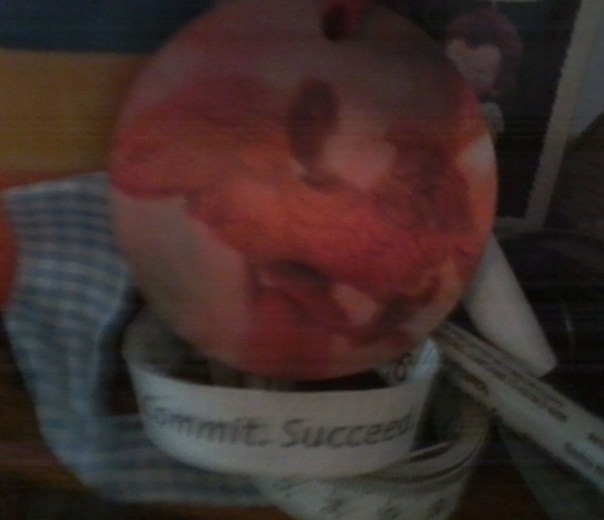
Toni died on Orthodox Christmas, January 6th, 2014. One of her dearest colleagues had made hologram ornaments for each of us, as remembrances; her face, and an angel, flickering back and forth, with her name on the back and the reminder: “Toni – an angel on earth, and now in heaven.”

I had saved mine on the secretary in the music room, amongst so many little things of sentimental value to me with which I could not part. Somehow, her face ended up propped against a mug and a Hallmark keepsake, between a tape measure, a ribbon, and a Sharpie, in random memorial.

This afternoon, I was in the midst of giving private Suzuki cello lessons in the music room. At one point, just after spending an intense phase of a session playing conductor to my newly appointed junior orchestra enrollee, I sat back down in my cello chair, to take a moment.

In that moment, I happened to glance over at the secretary.

There was Toni’s face, shimmering in hologram, smiling right at me.
But, right beneath her face, inexplicably, coming to me from the dimension where only Toni could reside, was the back of the tape measure upon which the ornament rested. And, this particular tape measure had extra room on its metric side, just enough for these words to appear, words which, at that moment, leaped out at me from across the chasm that separates us all from those who occupy the world which awaits:

“Commit. Succeed.”

Toni’s smiling face and, now, her caption: “Commit. Succeed.”


*******

As if that weren’t totally enough to transport me for hours thereafter, I vowed right then to capture this in photograph.

When I went for my phone, and aimed its lens at Toni’s face, the hologram had more to say. Instead of Toni’s face, all I could seem to get was the angel!

Frustrated, I pulled up my cello chair and sat, to stabilize my arm, thinking that all my excited trembling was causing the angel to phase over Toni’s face.

Amazingly, as soon as I sat, Toni reappeared, smiling impishly right at me.

I stood up. And, the angel, again, covered her face.

I could only see Toni unless I was seated, on my cello chair!

“Commit. Succeed.”

tonidilloncommitsucceed2016

Toni was telling me something. She was reminding me that it didn’t matter if I was pushing 60. It didn’t matter that I had retired, and only had some 14 students now instead of 800+. As long as I remained devoted to them, both I and they would reach the goals we’d set together.

All I had to do was stay in my cello chair. Be the cellist. Make the music. Teach my students the cello’s music. Some day we’d all rise up; but, until then, Toni’s angel would watch over us all.
tonidilloncommitangel


.

.

.

.

© Ruth Ann Scanzillo 9/12/16  All rights those of the author, whose story it is, and whose name appears above this line. Thank you for your respect – for Toni. ❤

littlebarefeetblog.com


Joe Rozler.

Buffalo, New York doesn’t get nearly enough press.

Or, I should say, it gets far too much of the dreary kind: Snow Belt Capital of The Rust Belt. The End. Thank you for coming.

But, nestled between the heart and soul of the big Buffalo is a bird. A song bird. His name is Joe and, if I had my way, he’d be the household word where everybody else calls home.

Granted, there are enough televised competitions already presenting the freshest young talent. And, occasionally, hidden gems have found their way to these stages. But, for a legend in his own time, there is no Tv show. That is because a Tv show could never do justice to the likes of Joe Rozler.

.

I met Joe in the halls of Fredonia State University, in 1980. He was probably loading equipment from a practice room to the trunk, heading off to a gig at the Jumping Frog on Route 5 for the weekend. All I remember was that voice, and a pair of legs that went on forever. And, his rendition of “Imagine” by John Lennon.

To say he seduced me is an understatement. I was completely overtaken, mesmerized by every sound he made and the way he made it. That, and the faint scent of Royal Spyce: he had me, with a warble and a hook, for life.

We were both the odd ones, returning after a two year absence – me, to earn enough to fund myself across the finish line, he to follow his bliss. Mark that last phrase; Joe never did anything but follow his bliss.

And, we’d both converged in the midst of completing that last bastion of fallback options, the Bachelor of Music in Music Education, a certificate that told the world in official terms that we were qualified to do what we were already born to. We were creatives; college was just where we came of age.

Or, I did. Joe was already the oldest soul on the block, caught in a body that bounded around like a nine year old at summer camp.

I’ll never know what precise configuration of DNA, or momentary inspiration, drove Joe to be who he was, but I do know this: Joe always knew. And, that was enough for Joe.

A natural rebel, he never wasted time submitting to any authority, or system, or institution that prevented him from living out his life’s intention. In school, he was already writing arrangements and selling them to a studio in Utah; in the summers, a metal band from Germany enlisted his keyboard wizardy for their tour.

But, the only thing Joe ever intended to do was sing, or play, or sing and play, the song.

Oh sure, we completed the requirements to obtain the degree. He played a piano recital; I played one for cello. Mine took six hours a day, and four months of those, committed to two works of music. Sitting in the audience for his, I remember thinking about hearing him do two straight sets at the Frog, engine revving until I thought he’d just pop right there in front of everybody, and deciding that this lone piano recital was just a parenthesis, merely the half time show of what would become the totality of his life.

As it turns out, thirty five years hence, I was right.

By now, there is no tune ever written that Joe has not sung. He, at the age of something like sixty,  is the oracle of the American songbook. He has become the song.

So, while lesser mortals steamroll through their days, clamoring for their piece of the greedy pie, bowing at the feet of expectation and the promise of reward, Joe Rozler will still be singing. And, you’ll swear you never heard anything else quite like him in your life.

All you have to do is find your way to Buffalo. You can shuffle, or you can hustle but, however you make the trip, Joe will be there when you arrive, just a couple blocks shy of Elmwood, at the piano. With his guitars and synth, and even a ukelele, nearby.  And, if you’re lucky enough to catch his solo act, he’ll play them all, nearly simultaneously, just for you.

The song will be yours. You’ll recognize it. You’ll remember it. You’ll know it. And, he’ll be bringing it on the most dazzling silver platter your eyes and ears could possibly behold.

Joe Rozler.

The American songbird.

Buffalo Hall of Fame.

Buffalo, New York.

.

.

.

.

© Ruth Ann Scanzillo 9/8/16      Please share, liberally. Thank you!

littlebarefeetblog.com

Honor.


[ formerly titled “Objection.”]

Dad never knew his parents. He heard about them both, from his Uncle Gabriel and Aunt Marietta in Springfield, Mass on the rare respite they’d give him from the foster home or the Walter E. Fernald School in Waverly. They’d tell him things – how his brute of a father sang opera that you could hear down the block, in between the storied rumors of his philandering….about his mother, being committed, speaking only Italian, with no defense….and, about his cousin, Jerry Marengi, who would go on to become a world famous Munchkin. These things we all, as his family, would carry forward in the form of his legend.

So, when Dad escaped the confines of his anonymity,  via the freight cars that carried him all the way to California from Boston, joining the US Army seemed almost logical. Free room and board, a hot meal (for which he’d panhandled so artfully as a self taught harmonica and bones man), a little physical agility, and he was in. In, to await deployment by the powers in place to submit him. No ties, no accountability; he was their easiest prey.

Fort Riley, Kansas was the first destination. Having had a few trumpet lessons in the Fernald school, he was ripe for lead bugle; each dawn and dusk, Private Anthony Scanzillo dutifully played Taps and Reveille on the horns the army gave him. Organizing, and then leading, a parade for the dignitaries on base earned him the rank of Corporal, which he held proudly until his death.

Dad, however, didn’t die in battle. Oh, no. He was one of the survivors.

In fact, when the war commenced, he being third fastest runner in his outfit they’d shipped him to Germany right off.

But, from that point, his always colorful stories were few; Dad would only speak in detail of the day he, as a member of the forward observing team of the 3rd armored, had to “infiltrate the enemy” at the Bulge. It was snowing, and he had a cough, and they had to shoot all the German prisoners on orders. But, they all lived through that hell and, in exchange for it, every infantryman received the Bronze Star.

Somewhere between enlisting and coming home the victor, there were less celebratory if more defining moments. There were the AWOLs. There was the all night guard duty. And, there was the guard house – where he’d frequently qualify, to all who would listen, his presence on Pearl Harbor Day, which was also his birthday. Dad’s role in all this emerged as a stand alone story; he wasn’t there for the medals.

I can’t remember what year it was. PBS was airing several mini-series, most of them documentaries, and the historian who stood out above the rest was Ken Burns. Ken Burns made his life work the chronicle of America, and he did it well. Never before seen footage, all the real thing, of everything from the jazz greats to, yes, American soldiers, in action.

Naturally, in the course of the Burns chronology of World War II, America’s most outstanding general received his own, multiple chapters. George S. Patton, the formidable, would be displayed in all his imposing force, with selected film clips in abundance.

One of these stopped me in my tracks.

I’ll never forget the evening. Probably dull of wit from a snacking binge, I had to be jolted awake by the scene. But, the image. The image was unmistakable.

Patton, Burns narrated, was always hard on his men. He never entertained the faint of heart, for any reason, chasing them down whenever he could. On one particular day, seems he’d found one: there, before our eyes, underscored by the unwitting Burns, was an army hospital, and one, lean, lone, raven haired soldier on a cot by the wall. The General loomed, raising his hand over this cowering young man, even in silent film barking forcefully at him to get up. The cameraman did not include the strike, but rumors were well circulated that this was part of the Patton package.

I recognized my father instantly.

No one knows when this happened. All anybody knew was Dad left the war a decorated forward observer, shell shocked, a victim of PTSD for the rest of his life. He could never tolerate fireworks (“screeming Meemies”) or sudden explosions of any kind, and would warn us repeatedly until his final years never, ever to come up behind him in the dark.

I wrote directly to Ken Burns, asking him to edit that segment from his series. The next time it aired, as God is my witness, actors portrayed that scene.

But, no actor could characterize my father as he was. Dad was a transparent innocent. He had none of the conventional role models, not a one. He was blessed with many gifts, one of them being the honest candor for which he was beloved by all. Dad was nobody’s victim.

God, in the wisdom mankind will never understand, spared Dad’s life – his, along with so many others, a fact for which the man himself always gave his Creator the glory. I like to think that Dad was protected because of his honesty. There is a fearlessness in such truth.

.

.

.

.

© Ruth Ann Scanzillo   5/30/16    All rights, in whole, in part, in word, and in letter, the sole property of the author, whose name appears above this line. Thank you for your respect.

littlebarefeetblog.com