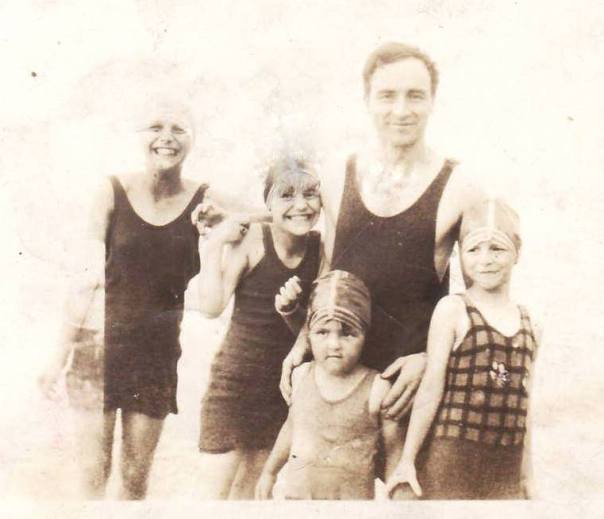
L to R: Dora Mae; Lydia Elisabeth (“Betty”); Henry Thomas Sweet; Front row, L to R: Martha Louise; Frances Magdalene;
My grandfather was a closet Republican.
Harry Truman was his hero.
Born in Wilkes-Barre, PA, of parents who’d hailed from Cornwall, England, he’d brought his young wife, Mae, across the Commonwealth on or about 1915 to build cranes at Bucyrus-Erie. Yet, Erie, newly founded, was up and coming and this move – for a working class conservative – was, at its heart, progressive.
But, after having attended a tent meeting led by Christian evangelist Billy Sunday, this naturally gruff dogmatist had experienced a conviction of belief which would solidify his politics for life. He brought with him to Erie a Bible thumping, street preacher’s passion and, after meeting two elders of the Plymouth Brethren at the City Mission, would join their fellowship at the Gospel Assembly Hall on East Avenue.
But, Henry Thomas Sweet would not register to vote.
He and the rest of his fellow fundamentalists would populate a small, but ardent, segment of this growing town. Their teachings were the most extreme among conservatives; preaching that only those things due Caesar would be rendered, the rest would be left up to Almighty God – who would put into office whom He will.
Still, Henry Sweet taught his family all the values upheld by the Republican party. Hard work having yielded sufficient income, all resources would be put toward the sustenance of family and a tenth toward “the Lord’s work”, all capital kept close to the vest for just such purposes. The downtrodden were to be regarded as slacking, irresponsible, vagrant, and were admonished – from the street corner pulpit – to “Get up out of the gutter, repent, and get a j.o.b.”
What Henry and Mae did was work. Raising four daughters, they used their hands – baking bread, and delivering it door to door; hooking and braiding rugs, from old, discarded wool coats rescued from the Salvation Army; planting vegetable gardens, and fruit trees, gathering their harvest (had poultry been permitted inside the city limits, they’d likely have had hens and chickens); “slaving” over the stove, preparing meals for the entire, extended family for every holiday and birthday celebration. Mae also sewed, repairing and altering all manner of clothing, and creating from remnants everything from pajamas to suits and spring coats, draperies, and furniture slip covers. Henry, after a long day at the crane factory, maintained every inch of their humble property on East 29th Street, as well as their royal blue Chrysler.
In his final decade, disaffected and excommunicated from the Brethren for “railing”, sunken into his harvest gold La-Z-Boy recliner in the northeast corner of the livingroom reading his National “Geographs” and his Bible, listening to talk radio (and, calling in daily), he would brood.
Sympathy was not part of his lexicon. Compassion was merely a concept, to be contemplated while meditating upon the person of the Christ. Weakness was not to be indulged; one was given a life, and one must take up the reins of it and serve the Lord with all one’s might. Paying income tax was the bane of existence.
Three of the four daughters carried on the traditions of his closet politics. All honorable citizens they, nevertheless, also never registered to vote – raising their children to accept having come out from among them, being separate, avowing to touch not the unclean thing. There were us, the elect bride of Christ, and there were them, the reprobate, damned to hellfire lest they repent and believe the Gospel.
I don’t know what happened, but something did. Time, and its inevitable evolution. Being Republican of mentality used to mean such noble (if self centered) intent, even if it appealed to the most narrow minded among them. One wonders if the GOP was forever affected by those who would only vote for he or she whom their God had ordained. Being a Democrat came to defy such selfish, belief driven ideals. In between, I now find myself – a registered Independent, caught, without a closet in which to hide. We are all part of America, a nation of so many countries, fighting to stay socially intact, more exposed than ever before, members of a globe of earthly peoples pushing and pulling and hanging on.
Not because of its grand hewn stone or stained glass, the height of its vaulted ceiling, or its inlaid flooring.
The chapel was cold because the door facing south was open – permitting access to the front by those unable (or, unwilling) to use the main entrance at the back of the church.
This open side door allowed the south westerly wind direction to thrust the front of the sanctuary into what, for my small frame and unprotected heart, were temperatures beyond chilly. And, those of us hired to play string quartet with added winds for the baccalaureate mass at the local university were very concerned. Not for our bodies, though they shivered, but for our valued instruments – collectively worth several thousand dollars, and not designed to withstand protracted cold drafts.
This was commencement week. Matriculating college seniors, being sent into the world to preach their own gospels by the administrators of the catholic institution granting their academic degrees, their presiding priest had chosen from among his readings passages intended to encourage all the young graduates in attendance. Wrapping my legs around the belly of my cello and crossing my arms over my heart I sat, listening keenly to the one from John’s Gospel, chapter 17:
“Holy Father, keep them in Thy Name which thou hast given me, that they be one…Those thou hast given me I have kept, and none of them is lost.”
My attention was captured by the single clause which followed that affirmation. Yes; Jesus had kept all those God had given him, and not one of them had perished – “ except he who was destined to be lost, that the scriptures might be fulfilled.”
Destined.
To be lost.
The mass ended, I hurried home – to get warm, and to do some digging.
My research brought me through several Biblical translations, finally discovering the International Standard Version. The King James, and those directly following ( including J.N.Darby’s, which I hold personally ) all maintained Judas to be “the son of perdition”; but, the International Standard referenced destiny in his characterization. Apparently, it was now considered archaic to think of the one who betrayed Jesus for a bag of silver as merely the “son of perdition”. Judas had been born to damnation, because it was his destiny.
Several months ago, I watched as something I held precious was snatched from me. Helpless to hold on to it, I could only hope that those determined to be capable of its rescue would step forward. But, due to the collective interests of everyone else involved, this was not to be. What I held dear had been unprotected; what I lost could not be saved.
Many argue that everything happens for a reason. In spite of the failings and fortitude of mere humans, the scripture of our lives will be fulfilled. For some, this means playing any number of roles, from savior to scapegoat. All for the greater good.
When one door opens, God closes another and opens a window. We choose both our entry, and our escape.
I just can’t, for the life of me, figure out why it has to be so damned cold.
 littlebarefeetblog