Category Archives: contemplative essays

various themes

Take It, Personally. *

*[FINAL DRAFT.]

Anxiety.

The community of social workers and psychologists might say that, statistically, the increase in anxiety disorders within American culture has reached epidemic proportions. And, the drugs dispensed to treat such disorders have become almost commonplace.

But, why?

Perhaps one of the reasons our society is experiencing so much of the old angst is because we spend too much time personalizing the behavior of those around us.

We absorb everything that happens. And, this informs not just our reactions, but our very selves.

The whole meditation movement, which seems to be keeping pace with the increase in social ills, is really based in turning attention inward. But, finding our Selves, for many of us, is a real task.

When we first step inside, we’re hit with a rush of Presences. And, furthermore, most of those we recognize as populating the space we call our inner life are ones about whom we don’t feel particularly fond.

Yes; that first “visit” with Self is somewhat of a shock.

For most of us, those we encounter first are family predecessors. Parents, relatives, an older sibling, spouses of same. Alive or dead, these all appear. Next, those who populate the belief system around which we were raised. Believe it or not, no pun intended, such systems shape our realities from birth and should never be underestimated. And, then, perhaps the most present: the administrators, the bosses, the supervisors, even some colleagues. Seems that, wading through all these characters, we can hardly find ourselves. Indeed, the room is full!

And, it isn’t their smiling faces we see; rather, it is the symbolic spectre they impose. Each seems to be present precisely to pass will and judgment on our right to live according to that which expresses our fullest self.

Parents bequeath to us any number of their own unrealized dreams; siblings, their competitive edge. Priests, ministers, Sunday School teachers, with their visceral tales of admonishment and condemnation. Employers, supervisors, each with the agenda that propelled them into management, hell bent on subserviating us via the systems they peddle. Together, they fill our subconscious with a collectively Expert Opinion. It’s a wonder we can claim a single motive as our own.

Most recently, we have all been grappling with an even larger entity, one which – in contrast to those which bespeak our past – is quite foreboding: our government.

Why, in a country wherein, for generations, its people never had to give a second thought to the day to day impact of those in power, we are now faced with forces that seek to alter the very quality of our hours. Living at the behest, even the mercy, of these used to be what we’d read about in History or Social Studies classes – viewing photos of long lines of citizens, living in remote nations, waiting to receive allotted food or clothing.

Now, such a scenario doesn’t seem so far off.

Perhaps we feel this more acutely during an election year. We realize that our government is designed to include, even welcome, our input – but, we feel less and less valued by that system. We are no longer sure that our vote will either matter or even be fairly counted. In fact, we’ve learned to suspect that the structure of our democracy has been intractably corrupted.

And, all of this compounds. When we awaken, there is an unspecified restlessness that meets us. It’s as if, by setting our feet on the floor beside the bed, we are opening the door of our psyche and letting them all in. And, they come, running.

Maybe some of us feel like this because of time of life. If we have lived beyond the developing years, the embarking years, the ambitious years, the competitive years, we’ve reached an established point of alleged arrival. The Now, for someone of our generation, is the Future for which we all planned.

And, plan we did.

We thought that, along with the modest financial freedom that came with foresight and diligence, the serenity and bliss that was sure to come from the belief that we had done the right thing would follow. Surprise; the scene is far from idyllic. Now, every constant upon which we based our decisions seems threatened.

Each of us needs to make greater effort, each day, to face the mirror in true solitude. We only think that those around us are watching and listening. They aren’t. They only see others as either a help or a hindrance to their own goals. While there may be a hierarchy in our niche of the world, we do not have to live as if our position within it is either dictated or determined. Change is still far from a luxury, and outcomes are potentially as varied as the paths open before us. At any moment, the only aspect of human behavior we really should personalize is the next step we, alone, will take.

And, take it we must, while we are still free.
.
.
.
.
.

© Ruth Ann Scanzillo
1/8/16
All rights those of the author, whose name appears above this line. Thank you.

littlebarefeetblog.com
Evidence for an American Original.

ChautauquaTreeStump

New Year’s Eve, 2016. The precipice of change.

Media press releases are already abuzz with the upcoming year’s promises, from the ridiculous to the sublime. Among them, one bit of news which, on its face, might seem of interest only to the relatively unimportant; apparently, the Board of Trustees of the Chautauqua Institution has just voted to replace its 100+ year old amphitheater with an alleged “replica”.

Their argument goes that the structure, weakened by years of neglect, is in danger of imploding.

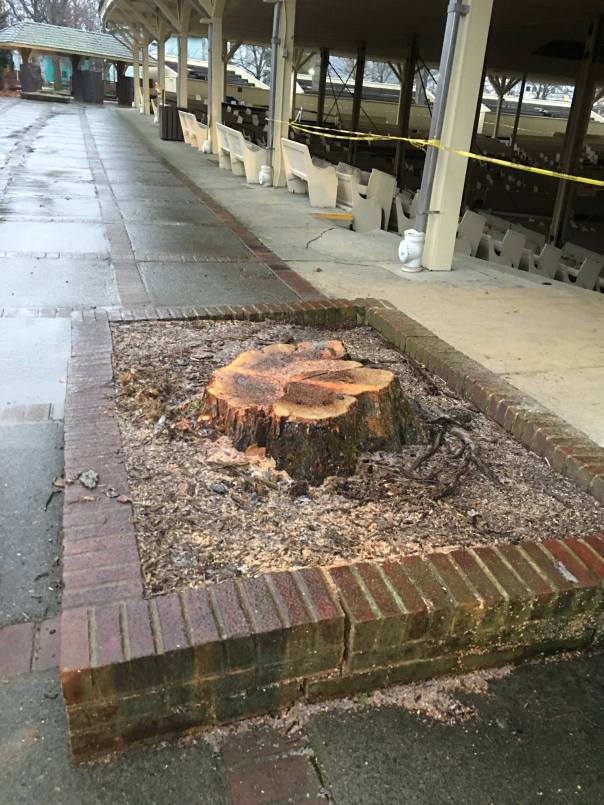
But, apparently, several surrounding trees – part of the canopy of a century of oaks – have just been destroyed, many of them as old as the amphitheater itself. The fact that these are already gone just might speak voluminously to what is really happening, here.

Had said Board a genuine interest in preserving the Institution’s historical mission, architect’s plans would never have included the removal of these 100 year old trees. This is all the evidence one needs to realize that the devoted residents of Chautauqua are being played. Getting the Board to agree by calling for a proposed “replica” only gives license to those in power for far more than an amphitheater; clearly, this writer suspects a gradual displacement of the entire Institution.

Chautauqua Institution was not founded as an entertainment venue. Read the history.

(paraphrased from ciweb.org): The Institution was established as a not-for-profit, 750-acre educational center beside Chautauqua Lake in southwestern New York State which grew to accommodate approximately 7,500 persons in residence on any day during a nine-week season, drawing a total of over 100,000 to its scheduled public events. To this day, over 8,000 students enroll annually in the Chautauqua Summer Schools which offer courses in art, music, dance, theater, writing skills and a wide variety of special interests. Succesfully founded in 1874 as an educational experiment in out-of-school, vacation learning, it broadened almost immediately beyond courses for Sunday school teachers to include academic subjects, music, art and physical education. Becoming Ecumenical in spirit and practice, Chautauqua’s Department of Religion presents distinguished religious leaders of many faiths from this country and abroad, both as preachers and teachers. In addition, the Chautauqua Literary and Scientific Circle (CLSC) was started in 1878 to provide those who could not afford the time or money to attend college the opportunity of acquiring the skills and essential knowledge of a College education. This spawned satellites, “daughter Chautauquas” around the world. The Chautauqua Symphony Orchestra, founded in 1929, now performs thrice weekly with leading soloists, and Chautauqua Dance also appears in the Amphitheater. The Institution continues to play a unique educational role today, offering studies on a vacation level, a more serious level and a professional level. In addition, there are enhanced learning opportunities within Chautauqua’s other programming. Music, the arts, religion, recreation and the pursuit of knowledge are all available. Younger and older students often share learning experiences in an open, congenial atmosphere.

Yes; evolving gracefully from its roots into a center for both religious, political, and artistic discourse, the Chautauqua Institution is an American original.

And, its Amphitheater is a national treasure.

I did some digging. Apparently, the Board consulted with FORECON, a forestry consulting firm, before destroying the trees that were growing several feet away from the structure (see the photo included above). FORECON appears to be in place to advise foresters regarding the proper care and maintenance of their trees, per their marketability as timber. I never once saw the term “preservation” anywhere in their descriptor.

Yes. To that certain, remote few, this oasis seems nothing more than a vast piece of select property. Somebody convinced somebody else to take the vulnerable amphitheater’s repair cause and morph it into their notion of revolutionary change.

There will be no revolution. Instead, watch for the opposite. Expect the new, 41.5 million dollar monstrosity to be fully equipped with a sound system capable of the kind of “smoke and mirrors” show equivalent to a Vegas magician. Look for technology producing decibels of tympanum-killing intensity. Such ideological changes should send its decades-long community of residents – intellects, writers, readers all, superior artists, reflective thinkers – running for the hills. Dissolution, waiting at the gate.

This appears to be the intent.

The Board’s defenders might argue that Chautauqua has always been about evolution and expansion. But, all it takes is a discerning mind to inspect the situation; calling for $41.5 million for a performance space is a recipe for destruction of more than a faulty amphitheater. The residents of the village, and its patrons, didn’t have to come up with that kind of cash alone. While asking it of them would have been obscene, I wonder if perhaps those who already donated to the Institution last year may come to discover that their monies were appropriated in ways that they never realized. This kind of stealth is only a couple genteel steps away from a coups; overtake the people, disempower them, and what is theirs is easily attained.

Predictably, money is poised to capture the mentality of the graceful, the elegant, the precious. Just like tasteless city “planners” notions of what constitutes “class” maraud the landscape, the proponents of such vapid notions likely stand ready to seize the entire village.

So, as we review and contemplate our own resolutions for the coming year, might the rest of us stand to defend the causes of institutional preservation. Wherever we can, might we resolve not just to speak out but to act against the powers of greed and covetousness that seek to demolish them. If we aren’t finally willing to resist these forces, they will succeed in destroying our very belief in the value of history, itself. And, once we turn our backs on our legacies, we condemn ourselves to a bleak and barren future.

The trees will be listening.

.

.

.

.© Ruth Ann Scanzillo 12/31/15

All rights explicitly those of the author, whose name appears above this line. Requests for reproduction, in quote or whole, should be made in writing to :  littlebarefeet@msn.com  Thank you, and Happy New Year!

littlebarefeetblog.com


Presence.


In Christmases past, there were always two kinds of folks: the Eves, and the Mornings. We were, because mum was always up, Mornings. And, it didn’t matter how late we stayed awake the night before; my little brother and I were out of bed, and always before we’d had enough sleep.

I think it might’ve been class related. Rich people opened gifts in the evening, after a posh meal and a high Catholic mass. Poor people liked to savor the sight, one more night; presents, we called them, falling over each other under the tree, in just the light from the strands wrapped around it.

In families where the cousins and grandparents lived nearby, that extra evening gave everybody more time to finish wrapping and delivering. For us, it was always an extended family affair; we had more than one gift for siblings and parents, plus something both for and from every cousin who came from across the street and around the corner and as far away as Lawrence Park.

When we were toddlers, I don’t even remember eating breakfast first. It was all about the living room floor, in pajamas and housecoats. Dad, sitting in the corner of the davenport, eyes closed, robe and slippers on.

Union Bank had a Christmas Club. This was a means of saving meager earnings, all year, so the windfall on Christmas morning could make up for all the sacrifice – that sacrifice, of course, being the exclusive domain of mum, who never bought a single thing for herself, ever, and made all her own clothes and ours, too.

Making mum her special Christmas card was always a big deal. And, in later years, finding her that one outstanding present, just like she had for us – several small, but one big, climactic box which, from her, meant a completely tailored suit or dress – was always the challenge; and, as the years passed, meeting this one successfully became more difficult. From me, the electric potato peeler and portable shower rail were two stand outs; she never had to use the peeler, and died before the shower rail ever became necessary.

We always, as children, had a real tree, too. Mum’s arthritis kept on, though and, once we reached our late teens, green branches made of twisted wire and flexible plastic needles took their permanent place. Yet, like everything else valued by the children of the Great Depression, the glass ornaments and lights as big as your grandfather’s thumb and table candles and window wreaths were as carefully brought out as they always had been, after the trunk was firmly set in its screws in the steel stand.

Dad, raised in an orphanage, had no need for any of this. He already knew that just being in a warm house, having had a solid night’s sleep, his brood all around him, waiting for some hot oatmeal, was more than enough. But, eyes closed, he’d be listening to us, with a smile on his face.

Memories like these are what make the present hard. Living in The Now is overrated; take me back, any day, to what we had growing up. Nobody could have ever told us how it would be later, and we wouldn’t have wanted to know. The Bible says that the poor ye will always have with you; but, there used to be a day when even those who had little could enjoy the reward of being alive, like the baby Jesus. Our parents knew that secret, and this is what I miss. Christmas, my friends, used to be for everyone.

.

.

.

© Ruth Ann Scanzillo  12/25/15  All rights those of the author. Merry Christmas!