Category Archives: classical music

“Do Not Be Afraid.”

“Do not be afraid………..
you……are mine.”   — Isaiah 43.
.
Choral music used to be a given in mainstream American life. From the patriotic holidays through the public school concerts, the sound of people singing in four part harmony presented by a collective larger than a family around a piano seemed impermeable by any shift in the cultural wind.
.
Little would any of us in arts education realize that the times, and the weather, would change so profoundly. In the five final years of my public tenure, I had to endure being told there would no longer be time in the daily elementary school schedule for a chorus class. And — my students!  Two part harmony, among primary aged children. But, oh. Yes. Better, so said the powers that assumed authority, that time be spent bouncing a ball around or chasing another – or, eating soy patties on roll with boiled vegetables. Time, and money, going instead toward that which bailed on a vital source of nourishment.
.
Nourishment, you argue. Singing with other humans as anything more than a casual diversion?
.
This past Friday night, I’d been invited to perform as cellist with the northwestern Pennsylvania District 2 Student High School Chorus. My instrument, a clarinet, and a horn, had been added to one of several pieces of music programmed for their public concert. And, we enjoyed our collaboration, immensely. The students had come from among the very best their schools had to offer, and their guest conductor was nothing short of a marvel.
Happy with our performance, we’d left the stage intending to take in the remainder of the concert. Waiting at the auditorium door for the signal of applause, we’d stepped discreetly into the back of the hall. The temperature elevated by a packed house, a rush of body heat flooded us. And, the room was dark. But, what was about to emanate from the fully illuminated stage would render all senses irrelevant.
.
I’d been impressed by Dr. Christopher Kiver, from the moment we’d been introduced. He had 200 + high school students in the palm of his hand. A Brit, his dry, observational humor infused his every breath, capturing the students’ imagination as he wove them from rhythmic riffs through the contours of phrase. Further investigation revealed that Dr. Kiver had proved his worth far and wide, known for his work with students at Penn State University and beyond.
.
But, what happened to me in the moments about to ensue as I stood in that dark auditorium I owe only in part to his expertise. The rest I leave to the reader, and the mysteries of the universe.
.
Dr. Kiver had chosen the program. A panel had chosen the soloists, from among several auditionees, one of whom had just completed her offering. The order of selections sat in my bag on the floor, unreadable in the dark. Two female choristers took their places across the front of the stage, and Dr. Kiver raised his baton to the choir.
.
Their pure unison tone began, hushed, absolutely controlled. Each syllable measured, the opening phrase emerged in one, clear, enveloping voice:
.
“Do……not………be……..afraid……………………………………….”
.
The harmonies expanded. Their sustain was seamless.
.
“Do…….not………be………afraid……………………………………..”
.
Without any warning, whatsoever, the choir became one voice in the firmament.
The verses unfolded; I recognized them as scripture. But, the music had transcended thought, to become the vehicle of the oracle of the divine.
.
Standing in the dark, I was a child again. The world around me, and everyone else, all of us terror-stricken, shell shocked, every institution threatened, all future expectations uncertain, but this voice. It were as if the God of my childhood were speaking directly to me, my eternal protector, the loving Creator who had promised me everlasting safety.
.
Tears poured down my face. Everyone around me was spellbound, as well. We were all collective witness to the deepest of human power, manifesting the very message for which we were starving, through the only art form that could possibly have carried it to us.  We didn’t have to fear. We had been redeemed. We were still loved, perfectly. And, our God had just sung us a lullaby.
.
……………………………………
….When you walk through the waters,
I’ll be with you;
you will never sink beneath the waves.
.
When the fire is burning all around you,
you will never be consumed by the flames.
.
When the fear of loneliness is looming,
then remember I am at your side.
.
When you dwell in the exile of a stranger,
remember you are precious in my eyes.
.
You are mine, O my child,
I am your Father,
and I love you with a perfect love.”
.
“Do Not Be Afraid” —  Philip Stopford.
.
.
© 2/6/16 Ruth Ann Scanzillo   — Thank you for your respect, both for the created work of Philip Stopford, the interpretation of Dr. Kiver and this, my piece.
littlebarefeetblog.com
The ERIE CHAMBER ORCHESTRA: He Built it, and They Came.

Way up in the northwest corner of Pennsylvania, there is actually a state park called Presque Isle. A 13 mile peninsula, this vacation destination draws tens of thousands, each summer, to its eleven public beaches, lagoons, campgrounds, and trails. The city which hosts this gem is called Erie, after the Great Lake which bears the same name. It is here where small, but emphatic, dreams are realized. This is the story of one of them.

The Erie Chamber Orchestra was founded over 35 years ago by the late Bruce Morton Wright. An African American raised by God-fearing parents, his vision took him well beyond the stereotype of his generation. Though he’d spent his early years as a jazz saxophonist, Bruce’s dream –  a sudden epiphany, coming to him while seated in the audience of an orchestral concert – was to create a symphonic ensemble of professionals that would present the music of the masters to any audience interested in attending, regardless of socio-economic status. To say that he realized this vision would be an understatement.

An Erie native, Wright qualified by earning a music degree from Mercyhurst College and then studying conducting, both in Vienna, Austria and Colombia, South America. Upon return from his training abroad, he formed the Erie Bayfront Orchestra. The unique feature of this orchestra was its “no ticket required” stature; admission, to every concert, was: FREE.

This ensemble caught the attention of one Charles Beyers, a local philanthropist, who offered a sizable trust through which the orchestra was able to sustain itself for many years. Via this support, the orchestra’s professional musicians were able to receive AF of M Union scale compensation for each “service” (every rehearsal and performance), and Maestro Wright a modest salary.

Though the name was eventually changed to the Erie Chamber Orchestra, its conditions for performance were not; musicians were still paid, at professional Union scale, and the audience’s admission was still free.

Over the decades which followed, the ECO could be seen and heard at such venues as the Villa outdoor promenade, aptly named “Music in the Air”, the Bayfront open amphitheater during the Erie Summer Festival of the Arts, and even served to originate what would become the Lake Erie Ballet Orchestra, with its annual production of Tschaikovsky’s “Nutcracker.” The regular season’s offerings were always heard at either Gannon’s Mary Seat of Wisdom Chapel, or the beloved St. Patrick’s Catholic Church.

Bruce, always a man of the people, was warm, accessible, and fiercely loyal both to his musicians and audience alike. He did the work of three people – planning the program, presenting it, and completing it, down to the stacking and hauling away of the last chair and music stand.

Sometime in the mid-90’s, CNN caught wind of this anomaly and sent its filming crew, to document the story and to interview Bruce Wright. The feature appeared nationally, quite a thrill for both the musicians and the entire community of loyal audience members. All were especially proud of Bruce, for being recognized in such grand style.

Several years prior to the illness which took his life, Bruce sold the orchestra’s rights to Gannon University. Gannon committed to the continuing support of the ECO’s mission, maintaining its seasonal offerings while upholding its promise to provide music free of charge to the public. Gannon pays the salaries of both the conductor and the business manager, and provides a marketing budget for the seasonal calendar and any outreach efforts.

The Erie Chamber Orchestra is not, nor has it ever been, affiliated with the Erie Philharmonic Orchestra. Each is a distinct entity, with both a distinct financial structure and season calendar. The only similarity, which many may note, is that both orchestras share some personnel – primarily across the string sections.

Like the Erie Philharmonic, professional personnel which populate the Erie Chamber Orchestra hail from both the city of Erie, its surrounding townships, greater Erie County, Meadville, and Pittsburgh, as well as university centers in Western New York and Eastern Ohio.

Maestro Matthew Kraemer, originally associated with the Buffalo Philharmonic, succeeded Bruce Wright following the maestro’s death in 2011. Though he is leaving in 2017, his efforts have expanded the orchestra’s repertoire and personnel considerably. Regional professionals in attendance have remarked at the quality, both of the ensemble and its musical execution, of the new “ECO”. Notable soloists, just in the past two seasons, have included numerous Eastman School of Music faculty, as well as Concertmaster David Kim of the Philadelphia Orchestra, cellist Roman Mekinulov, violinists Rachel Barton Pine and Michael Ludwig, and even actor Harry J. Lennix as narrator for Stravinsky’s “L’Histoire du Soldat”.

We are a proud and durable lot at the ECO. We welcome both your support as audience attendees, and your generous donations toward our financial sustainability. If you have never paid a visit to an ECO performance, go to the Erie Chamber Orchestra at Gannon University and email our GM, Camille Pierce. Request that you be placed on the mailing list. She will send you a season brochure! All you’ll need, beyond that, are the wheels to take you to either Luther Memorial or First Presbyterian Church of the Covenant, where we perform in season 2016-17. There really isn’t an affordable venue in Erie County big enough or acoustically suited to the needs of our orchestra, so these churches have opened their sanctuaries for our use, an act of generosity for which we are very, very grateful.

The 2016-17 concert schedule has brought the ECO into yet another season of candidates vying for the baton. Two down, three to go!

Hope to see you, soon! Bruce would be so happy. And, in his memory, we would be, too.

Thanks!

Ruth Ann Scanzillo
principal cello,
Erie Chamber Orchestra.

littlebarefeetblog.com

Evidence for an American Original.

ChautauquaTreeStump

New Year’s Eve, 2016. The precipice of change.

Media press releases are already abuzz with the upcoming year’s promises, from the ridiculous to the sublime. Among them, one bit of news which, on its face, might seem of interest only to the relatively unimportant; apparently, the Board of Trustees of the Chautauqua Institution has just voted to replace its 100+ year old amphitheater with an alleged “replica”.

Their argument goes that the structure, weakened by years of neglect, is in danger of imploding.

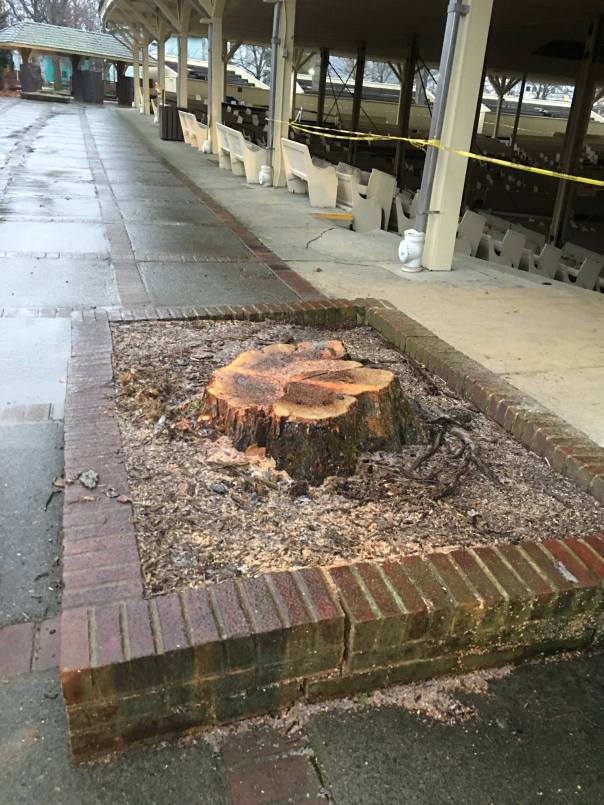
But, apparently, several surrounding trees – part of the canopy of a century of oaks – have just been destroyed, many of them as old as the amphitheater itself. The fact that these are already gone just might speak voluminously to what is really happening, here.

Had said Board a genuine interest in preserving the Institution’s historical mission, architect’s plans would never have included the removal of these 100 year old trees. This is all the evidence one needs to realize that the devoted residents of Chautauqua are being played. Getting the Board to agree by calling for a proposed “replica” only gives license to those in power for far more than an amphitheater; clearly, this writer suspects a gradual displacement of the entire Institution.

Chautauqua Institution was not founded as an entertainment venue. Read the history.

(paraphrased from ciweb.org): The Institution was established as a not-for-profit, 750-acre educational center beside Chautauqua Lake in southwestern New York State which grew to accommodate approximately 7,500 persons in residence on any day during a nine-week season, drawing a total of over 100,000 to its scheduled public events. To this day, over 8,000 students enroll annually in the Chautauqua Summer Schools which offer courses in art, music, dance, theater, writing skills and a wide variety of special interests. Succesfully founded in 1874 as an educational experiment in out-of-school, vacation learning, it broadened almost immediately beyond courses for Sunday school teachers to include academic subjects, music, art and physical education. Becoming Ecumenical in spirit and practice, Chautauqua’s Department of Religion presents distinguished religious leaders of many faiths from this country and abroad, both as preachers and teachers. In addition, the Chautauqua Literary and Scientific Circle (CLSC) was started in 1878 to provide those who could not afford the time or money to attend college the opportunity of acquiring the skills and essential knowledge of a College education. This spawned satellites, “daughter Chautauquas” around the world. The Chautauqua Symphony Orchestra, founded in 1929, now performs thrice weekly with leading soloists, and Chautauqua Dance also appears in the Amphitheater. The Institution continues to play a unique educational role today, offering studies on a vacation level, a more serious level and a professional level. In addition, there are enhanced learning opportunities within Chautauqua’s other programming. Music, the arts, religion, recreation and the pursuit of knowledge are all available. Younger and older students often share learning experiences in an open, congenial atmosphere.

Yes; evolving gracefully from its roots into a center for both religious, political, and artistic discourse, the Chautauqua Institution is an American original.

And, its Amphitheater is a national treasure.

I did some digging. Apparently, the Board consulted with FORECON, a forestry consulting firm, before destroying the trees that were growing several feet away from the structure (see the photo included above). FORECON appears to be in place to advise foresters regarding the proper care and maintenance of their trees, per their marketability as timber. I never once saw the term “preservation” anywhere in their descriptor.

Yes. To that certain, remote few, this oasis seems nothing more than a vast piece of select property. Somebody convinced somebody else to take the vulnerable amphitheater’s repair cause and morph it into their notion of revolutionary change.

There will be no revolution. Instead, watch for the opposite. Expect the new, 41.5 million dollar monstrosity to be fully equipped with a sound system capable of the kind of “smoke and mirrors” show equivalent to a Vegas magician. Look for technology producing decibels of tympanum-killing intensity. Such ideological changes should send its decades-long community of residents – intellects, writers, readers all, superior artists, reflective thinkers – running for the hills. Dissolution, waiting at the gate.

This appears to be the intent.

The Board’s defenders might argue that Chautauqua has always been about evolution and expansion. But, all it takes is a discerning mind to inspect the situation; calling for $41.5 million for a performance space is a recipe for destruction of more than a faulty amphitheater. The residents of the village, and its patrons, didn’t have to come up with that kind of cash alone. While asking it of them would have been obscene, I wonder if perhaps those who already donated to the Institution last year may come to discover that their monies were appropriated in ways that they never realized. This kind of stealth is only a couple genteel steps away from a coups; overtake the people, disempower them, and what is theirs is easily attained.

Predictably, money is poised to capture the mentality of the graceful, the elegant, the precious. Just like tasteless city “planners” notions of what constitutes “class” maraud the landscape, the proponents of such vapid notions likely stand ready to seize the entire village.

So, as we review and contemplate our own resolutions for the coming year, might the rest of us stand to defend the causes of institutional preservation. Wherever we can, might we resolve not just to speak out but to act against the powers of greed and covetousness that seek to demolish them. If we aren’t finally willing to resist these forces, they will succeed in destroying our very belief in the value of history, itself. And, once we turn our backs on our legacies, we condemn ourselves to a bleak and barren future.

The trees will be listening.

.

.

.

.© Ruth Ann Scanzillo 12/31/15

All rights explicitly those of the author, whose name appears above this line. Requests for reproduction, in quote or whole, should be made in writing to :  littlebarefeet@msn.com  Thank you, and Happy New Year!

littlebarefeetblog.com