Category Archives: sociology

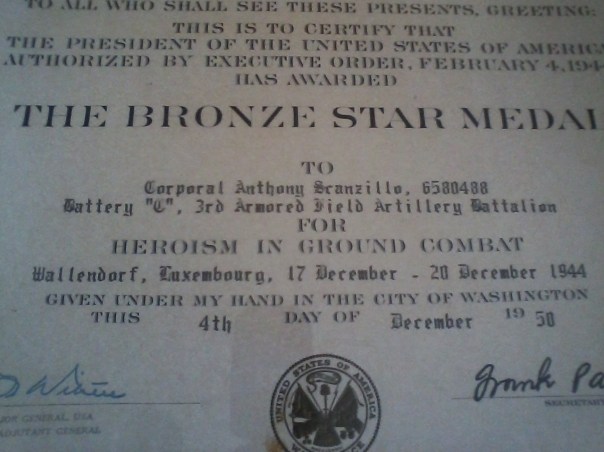
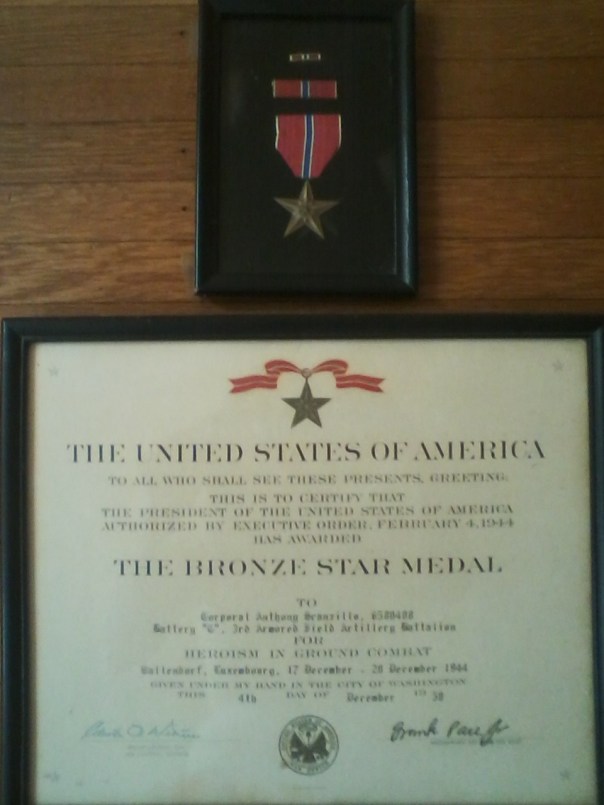
The Bronze.

DAD'SBRONZECLOSEUPDAD'SBRONZECERTIFDad'sBronzeStar

Dad, always full of fascinating stories, remembered these details consistently every time he recounted them.

Surrounded by “Krauts”.

Snowing.

A tickle in his throat.

A sugar cube, passed down the silent line, to cut his cough.

Orders: “Infiltrate. Take nothing with you.”

Three days, in the snow.

Three.

Days.

Cpl. Anthony Scanzillo, part of the forward observing team.

Hodges, the commanding officer; General calling the play: George S. Patton.*

The rest, profoundly, history.

I am still not quite sure how to thank my father for all this. Thank him…..for enlisting in the US Army when, as a 20-something vagabond orphan, the military service might have been the only place he could go for three square meals and a bed?….Thank him…..for sticking it out once the war hit, promising his new wife he’d come back to her from Germany?…….Thank him…..for enduring abject fear, horrifyingly explosive sudden death all around him, the demand of primitive conditions and unending misery?…….Thank him…..for using all his internal resources to survive, to come home, to open his barber business, to marry mum twice so that I could be brought into the world.

Thank you, Dad. They tell me that what you did saved the world from an oppressive dictator whose mentality could have overtaken freedom itself. I hope they’re right.

I’m just glad you came home.

***


*Footnote:

[ He bit his lip, and kept trudging. And followed orders, and kept breathing, and kept holding his breath, and never closed his eyes (I knew my father. He never closed his eyes, mark that.) and kept watching, and kept looking, and kept listening, and kept trudging, and stood stalk still, and liked to have died, and then the orders came down, and the German prisoners were lined up, and shot dead, and then more trudging, and straight ahead, and no thinking, and then suddenly the orders came down, and surprise attack, and blood, and heads being blown off right beside him, and ear splitting booms, and meemies, screaming, and carnage, and more shooting, and then the orders came down, and they all turned, and back they trudged, and trudged, and trudged, and then they were clear. And, the end. Of that. And, probably peeing and drinking, and eating, and smoking, and finally sleeping.

Dad came home with PTSD that never left him. He was 95, and it still haunted him. My one, retrospective relief is that he died dreaming, in feverish sepsis, turning his left wrist like he was still playing the bones.]

.

.

.

© Ruth Ann Scanzillo 7/3/16  All rights those of the author, including the photographs, whose story it is, and whose name appears above this line. Thank you for your respect.

littlebarefeetblog.com

The Voice of My Generation.

The Chinese boy’s name was Doonk. Or, at least that’s how he pronounced it when I asked him who he was. And, he’d done everything humanly possible to make my take out buffet dinner as delectable, if gluten and soy free, as he could.

But, sometimes,  we’re just in the right place at the wrong time.

I brought my dinner home, alright. Got it all set up on the sofa, and turned on the TV.

There he was.

Catching the tail end of the finale of his live one at PBS’ Austin City Limits just a day or two before, I’d heard enough to know that James Taylor and his band of back up singers and musicians had been one of the all time best that series had ever known. The collective light in everybody’s eyes told that tale.

And, this night, the time on the clock said 7:06 p.m.; with my carefully selected repast laid out before me, I’d be able to enjoy nearly the whole hour of his concert! This was more than the old single girl had bargained for, on such a Sunday evening in early summer.

Eagerly, I dug in to my meal, glancing up every so often at the radiant face of the man who had clearly come out the other end of a life that had borne its depths with what could only be termed a riding high. Smiling broadly as he sang, segueing from one song to the next with that rare fluency that only comes with the perfect band, the perfect night, the perfect scene, the perfect moment…..he was the perfected artist. As attuned to him as if they were inside his head were the flush, back up vocals, a wailing sax, Jimmy Johnson’s solo bass, and the subtle drumming of Steve Gadd always just under the lead of his clean, smoothe tenor.

To the innocent, Taylor seemed uncontainably happy.

But, I’m old, now. Just old enough. Old enough to know most of the stories – about people, and places, and things. There’s rarely a newsbyte or a bit of sound that comes across the ticker that doesn’t, in some way, trigger an associated memory. My fascination with the pure joy emanating from Taylor’s face was informed. His was a story of triumph.

In the early years of his fame, James Taylor was our lead balladeer. When we were down, or troubled, or we just needed a helping hand, that song……..that song brought it all home, for us. We didn’t know until the next decade that his own life would rise to the heights and plummet to the pit of despair; he would come out to us, eventually, not as a spokesman, but as a confessor of sorts for the rest of the bi-polar community.

And so, as I sat over my Chinese take out, I soaked up James Taylor in his finest hour, feeling the celebratory relief of a life that had come up out of its own troubles, coasting in conquering mode.

But, as if to gently prod my sensibilities, my taste buds started talking back. How audacious of them, really, in the midst of a perfect sensory evening. What was that bitter residue that seemed to be saturating every mouthful of my banquet?

Choosing my buffet meal with alleged care for only protein sources and clean nutrition, one fleeting, personal moment of weakness had permitted two small squares of red jello to pile on before I’d closed the styrofoam container. These had, in the emerging summer heat, decided to melt. Liquified, this red stream had meandered under the whole dinner, soaking up the rice, the noodles, the cheesy potatoes, the shrimp; and, worst part was, this was the artificially sweetened variety. The whole meal had been tainted by an alien chemical; it tasted awful.

Now, everybody knows – at least, anybody who reads a nutritional report produced by health conscious experts – that artificial sweeteners are, in large part, toxic. There is a larger point, here.

My generation is in that rare place: still comparatively lucid, and able to connect vast amounts of information from the past to the present. We are in the decade of now or never, the one that nobody has to tell us is our moment. What’s important, here, is that we go beyond realizing and actually do something with it.

We can look back, while we still have perspective; we can look ahead, while we still have our health. We can make ourselves available to any and everyone who seeks to benefit from our various wisdoms, and we can do even more: we can change our course completely without any concern for the judgments of others. We can break brand new ground, with far more than the idealistic notions of our youth; we now have the freedom to make sound decisions born of  the vision that comes with the experience of knowing.

Had I been some twenty years younger, that melted red jello, that faux food would have ruined my entire evening. I would have brooded at the injustice of it all, maybe even written a letter to the restaurant owner berating his choice of dessert options.

But, James Taylor’s voice was still there, its beauty and clarity undiminished, to teach me everything I needed to know. There was a bigger picture, finally, even if I had needed almost a lifetime to see it. There would be another Sunday night, more Chinese take out to be had. Duke, as his name turned out to be, would greet me cheerily the next time, with added recognition.

And, there didn’t have to be any more melting jello embittering anything. We could all rejoice with the voice of our own, small triumphs.

.

.

.

.

© Ruth Ann Scanzillo   6/18/16  All rights those of the author, in whole and/or in part, whose name appears above this line. Thank you for your respec. Bon Appetit.

littlebarefeetblog.com


The Opera Wars.


*AUTHOR’S NOTE:  Periodic Update:  All rights to these pieces at littlebarefeetblog.com, in whole and in part are, unless otherwise specified, strictly those of the author. Thank you for your respect.

.

Possibly the most profound gift from the universe to humanity on this earth is the singing voice.

After last night’s presentation of Rachmaninoff’s All-Night Vigil Vespers, offered by the combined choirs of Mercyhurst University, the Erie Renaissance Singers, Chautauqua Chamber Singers, and Church of Christ Savior –  masterfully directed by Rebecca Ryan, Andrija Andelic, and Vladimir Gidenko with soloists  Ainsley Ryan and Brandon Miller, any witness concluding otherwise would have to be missing either a cerebral lobe, or a soul.

Rachmaninoff captured the depth of an entire nation’s reverence for its God and Christ, and set as sacrament voices, alone – in polyphonic unisons, in woven harmonies, in unique tonal rhythms and rapturous resolutions – that would forever mark his masterpiece in ironic, final testament to a people who would soon be stripped of their right to worship at all. The result was repeatedly, and increasingly, breathtaking.

A work, of this magnitude, begged a mass choir. And, the many voices came, from four distinct ensembles, so willing to collaborate to make this music a reality.

Morning reflection took me back to the early ’90s and a graduate course in Baroque music, taught by Associate Professor Jeremy L. Smith at SUNY Fredonia.

Now, a good historian will address such a broad topic by constructing a course around highlights that were in some sense pivotal to the development of the style of the period. Smith, in his rich academic wisdom, chose to cover Bach/Vivaldi; castrati; and, the infamous opera house wars.

I was remembering, on this morning, the latter.

If you search the internet, you won’t find anything substantial about the Baroque opera house wars. But, Jeremy L. Smith had his sources. There were two major theaters in Europe during the Baroque era, and they so bitterly competed for pre-eminence that many underhanded and spiteful attempts were made to squelch the other, including paid infiltrators who would make raucous, vulgar and berating sounds throughout their competitors’ productions. One house was even successfully shut down by its opposition! Easy to wonder if the current American political system of “smear” campaigns takes its lesson from this regrettable chapter in history.

In the West, large metropolitan areas have a distinct advantage; should rifts occur within any performance discipline, those alienated by its effects can just move across town, birth new entities, and watch them rise from the rubble. Entire neighborhoods welcome the new asset, their audiences ready, eagerly awaiting. In fact, following the model of organic cell division, this could actually be considered a healthy evolution, one more likely to ultimately preserve the art as life form.

But, small towns have a problem.

If any one inadvertently, unwittingly, or otherwise unintentionally offends, there might very well be no place to go. The gossips, made up of the variously frustrated, powerless, or mediocre, are equally eager, and the news of the offense is their fodder.

Becoming the topic of public conversation only serves to inflate the value of any disagreement or misunderstanding. Before long, alliances form – usually against the hapless ones who managed to bring the insult. But, because proximity is the issue, the decision to leave the group is far from liberating; rather, those who do merely find themselves outsiders, maligned in their own locale. Any who choose to remain endure the negative energy which imposes upon their efforts.

It is with no small wonder, therefore, that those who use their voices in combined song commit to the enterprise without rancor. In reality, singing well requires a mind in congruence with the body which bears it; animosity in the heart can only produce a shrill and ego-driven outcome.

This is not what anyone heard coming from the combined choirs on Sunday night. The one hundred twenty voices were one strong, students of music, adult amateurs and professionals, people of all persuasions unified by purpose, melded by Rachmaninoff’s masterwork, mobilized by the devoted heart and determined spirit of Rebecca Ryan. In such a place of communing unity, a true chorale emerges – the singular voice of the created, manifesting its Creator’s song.

In such a place, no war of any kind is possible.

.

.

.

.

© Ruth Ann Scanzillo  5/16/16   All rights those of the author, whose name appears above this line. Thank you for your respect.

littlebarefeetblog.com